Tuesday, March 10, 2015

Share Favorite Apps, Sites, and Resources for Learning with Graphite Bulletin Boards

When students can bring or access devices for learning, teachers want to figure out the best resources. To do that they have Graphite™. Graphite is a free service from Common Sense Education designed to help preK-12 educators discover, use, and share the best apps, games, websites, and digital curricula for their students by providing unbiased, rigorous ratings and practical insights from our active community of teachers.

save image
This is what a collection of boards looks like. 

Teachers can get on Graphite and create boards of the best learning resources for any subject. They can start by checking out the boards created by Common Sense Media for Elementary, Secondary, and K-12 in the chart below.  

Elementary
Secondary
K-12


Want to share your favorite online resources? Sign up for Graphite.org and get started!

Sunday, March 8, 2015

#EdTech Companies Need to Be On Social Media, But Not the Way They Think

BRANDS ARE WASTING TIME AND MONEY ON FACEBOOK AND TWITTER, REPORT SAYS

"STOP MAKING FACEBOOK THE CENTER OF YOUR RELATIONSHIP MARKETING EFFORTS," SAYS NATE ELLIOTT, VP AND PRINCIPAL ANALYST AT FORRESTER.

WRONG!

Headlines like this from Fast Company have it all wrong. Being on social media is right for companies but they need to know how to do it the right way. The right way is not having a social media presence that's all about you. It's finding your audience and interacting with them in meaningful ways. It means giving companies the opportunity to put a face behind a brand. It also means providing a useful service for clients and finding the right partners.

I want more »

Saturday, March 7, 2015

The Hottest Posts Everybody's Reading

Here’s the roundup of what's been popular on The Innovative Educator blog. Below you’ll see the top posts along with the number of page views. I hope there's something that looks of interest to you.  If it does, check it out. If you’re inspired use one of those icons below the post to share it with others and/or leave a comment.


Entry
Pageviews
Jul 8, 2012,
15031
Aug 24, 2010,
5555
Feb 3, 2015,
2480
Feb 15, 2015,
2320
Feb 16, 2013,
2288
Jun 13, 2013,
2115
Feb 24, 2015,
2042
Feb 22, 2015,
1948
Feb 17, 2015,
1376
Mar 1, 2015,
1282

Thursday, March 5, 2015

#ThrowbackThursday - Promote Engaging Technologies Even Though Schools Filter Them

Today's #ThrowbackThursday brings us to a post I wrote about the importance of incorporating social media and student devices into learning even if it is blocked or banned in schools. What a difference a half dozen or so years make! Today, social media is embraced by districts such as New York City and this week the long-standing ban on cell phones has been lifted. 

Back then I was running a Ning network for The Innovative Educator blog. Since then, Ning is out and The Innovative Educator Facebook group is in and boasting several thousand members.

Written: May 11, 2008
I want more »

Tuesday, March 3, 2015

Get Smart by Texting w/ @Text_Engine

When Teaching Generation Text was published in 2011 there were numerous ways to use text-only enabled phones for learning.  This was great for students and families who didn't have access to smartphones.  Back then there were terrific tools like Google SMS, Cha Cha, Wiffiti, and 4info. One by one as smartphones took the front seat, texting tools like those faded away, until now. 

Text Engine was developed to offer cell phone users a means to search the web using their text messaging service. This is great news for educators and students in low-income and rural communities.  

And that's a good thing, because while smartphones are popular, there is still a great need for text-only services in low-income and rural districts. There is also a need in districts like NYC that empower students to bring their own devices to school, but don't have the means to enable students to connect to the internet.  
I want more »

Sunday, March 1, 2015

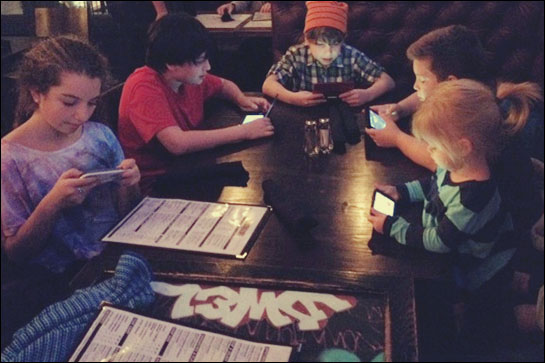
Screen time: It's not about how much. It's about how.

Editor's Note: A version of this post was originally posted on career advice expert, Penelope Trunk's education blog. If you'd rather read it (and the comments) there, go here.  

There’s nothing the press likes better than a story that generates real panic for teachers and parents…especially when it has the stamp of science to give a the panic an extra edge.
That’s exactly what happened when the media (Scientific American, Wall Street Journal,CNN, New York Times) ran a story about the American Association of Pediatrics (AAP)recommendations on children and screen time. One to two hours a day for children older than 2, they said, and no screen time at all for those younger than 2. Longer than that is dangerous to their health and their development.
An educator or parent today reading this probably had one of these reactions:
1.  You are a failure because your students are in front of screens much more than 1 or 2 hours a day.
2.  You don’t let students use computers so you’re good.
OR 
3.  Seriously? What year is this? Who is doing this research?
If you fit into the third reaction, you are likely someone who has seen amazing learning from screen time for your young people: building, creating, coding, reading, writing, and more.
Why would adults want to limit that?
We wouldn’t.
So why would the AAP make such out-of-touch recommendations?
I want more »